If you’re a marketer or content writer, you’ve undoubtedly noticed how commonplace AI technologies are these days. And really? The majority of them make the same claims: improved SEO and quicker writing. However, in practice, not all AI writing tools are created equal.
Some provide you with generic content that seems to have been written by a robot. Others genuinely assist you in improving your writing without compromising your style or turning your writing into keyword soup.
Over the past few years, I’ve tested these tools—some as part of my everyday work, others merely to check if they live up to the promise. I’ll be sharing my favorite choices with you in this article.
What Are AI Writing Tools?
Software programs that use artificial intelligence to assist with content creation are known as AI writing tools. They are a kind of AI SEO tool that may produce text, offer suggestions, enhance your writing, or manage particular steps in the content creation process, such as SEO optimization, research, or outlining.
Some tools concentrate on short-form content, such as social media postings and advertisements. Others are designed for blog entries and lengthy articles. For content work, keyword data, brand voice controls, workflow connections, and high-quality output that doesn’t seem like it was written by a robot, the best ones combine AI power with features that really matter.
Why Are AI Writing Tools Important for Your Workflow?
The statistics demonstrate that using AI technologies into your content marketing process can greatly speed up your workflow and increase search exposure in addition to just relieving you of some of your job. A study by All About AI claims that companies employing AI report 61% increased productivity and that AI SEO solutions accelerate content development by an average of 430%. When research, drafting, editing, and formatting are taken into account, writing a 500-word blog article by hand often takes four hours. In the meantime, content marketing experts can reduce their weekly content creation time by roughly 12.3 hours by using AI writing tools.
However, speed isn’t the only advantage. You can increase your output without burning out since writers who use AI tools generate up to 50% more content. Additionally, human-edited AI material converts 21% better than entirely human-written content when done correctly, which means you’re leading and amending the AI rather than merely copying and pasting.
Here, “human-edited” is crucial. Writers are not being replaced by AI. They are gaining leverage as a result. Fact-checking, adding your viewpoint, and making sure the text sounds like you are still necessary. However, the heavy work, such as the first draft, the framework, and the research, is completed more quickly.
You’re losing out on productivity if you’re spending hours creating material that might be completed in a much shorter amount of time. These resources are available to assist you at every stage.
How to Choose the Right AI Writing Tool for You
You must determine what is truly important for your job before you begin comparing features and costs. Because what you’re trying to do determines which tool is “best.”
Here’s what I look at:
SEO Capability: Not every AI writing tool provides you with the SEO information required to produce content that ranks. Do they truly assist you in comprehending search intent and organizing your blog entries, or are they merely keyword stuffers? Real keyword data is provided by certain tools. Others merely speculate.
Writing Quality: Does the output require a complete rewrite, or can it be used as is? It’s a problem if you’re spending an hour revising something that should have saved you time.
Workflow compatibility: Does it align with your current workflow? A program that requires you to copy and paste across five distinct windows quickly becomes unpleasant if you use Google Docs or WordPress.
Pricing: Free trials are fantastic, but what happens if you need to use it on a daily basis? Certain tools charge by the word. Some have monthly charges that are fixed. Be aware of the situation you are entering.
Integrations: Does it integrate with your project management software, SEO tools, or CMS? The less apps you have to manage, the better.
Accuracy and reliability: Remember that AI has hallucinations. It invents things. You need a technology that reduces that or simplifies fact-checking. It is not worth the risk to publish misleading material because your AI tool became inventive.
So consider what you really need. Keyword data is more important than brand voice elements when developing SEO content. Templates and tone management may be your top priorities while writing marketing copy.
Top AI Writing Tools to Watch in 2026
These are the five items that were chosen. You should take the time to check them out because they all do something well enough.
NightOwl: AI writing based on actual keyword data. This one is made just for SEO if that’s your primary goal.
ChatGPT: Everyone knows this tool. Excellent for research, writing, brainstorming, and pretty much anything else you can think of. Not specialized, yet adaptable.
Copy.ai: designed for marketers who require quick, impactful, and concise content. It excels in product descriptions, social media posts, and ad content.
Frase: SEO-focused articles and content summaries. Managing a content pipeline greatly benefits from having the ability to research, outline, write, and optimize all in one location.
Jasper AI: long-form material with a consistent brand voice. Jasper is worth considering if you write a lot and want it to sound like you (or your brand).
1. NightOwl (by Nightwatch)
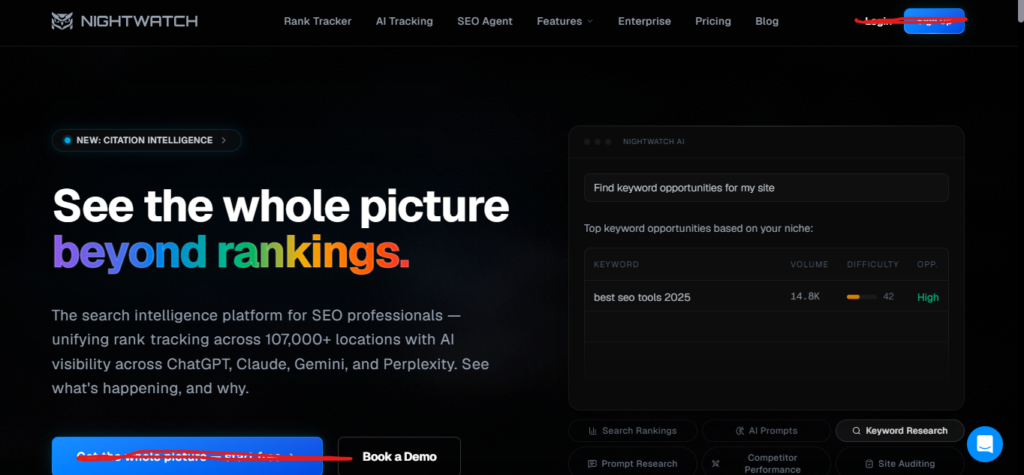
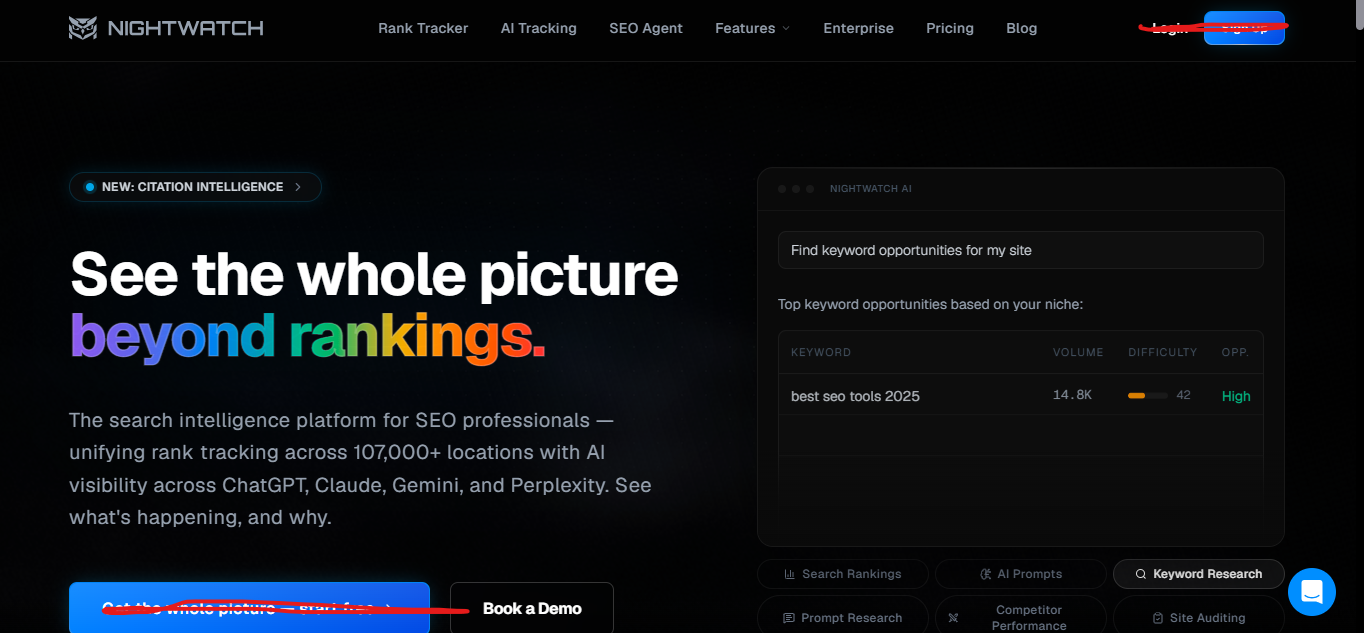
The Nightwatch platform comes with a comprehensive SEO automation tool called NightOwl. It manages content planning, technical audits, keyword research, and SERP analysis without the typical spreadsheet mayhem. NightOwl provides you with ranking, actionable SEO methods that you can use right away, in contrast to the majority of AI writing tools that only recommend material.
AI Writing Capabilities
NightOwl can help you produce SEO-friendly pages that rank and convert by identifying high-value keyword opportunities, analyzing top-performing content, and offering structured content suggestions. In order to increase the relevancy of your content, it also provides contextual recommendations, such as internal linking opportunities, topic coverage gaps, and guidance on keyword usage.
2. ChatGPT
The AI tool that everyone is familiar with is ChatGPT. By the end of 2024, it had 300 million weekly active users, and for good cause. It is accessible, adaptable, and continuously evolving. The most recent iteration, GPT-4o (published in May 2024), is a multimodal model with real-time text, image, and audio processing capabilities. This implies that you are able to voice chat with a PDF, ask it questions, and upload a screenshot.

AI Writing Capabilities
OpenAI’s most powerful writing model to date, GPT-5, assists you in transforming raw concepts into engaging writing with literary depth and rhythm. From brief emails to lengthy information like blog entries, reports, and technical documentation, it manages it all. Instead than depending only on out-of-date training data, ChatGPT now incorporates web search capabilities to retrieve up-to-date information. Additionally, it provides Canvas, a collaboration tool that facilitates teamwork on projects.
3. Copy.ai
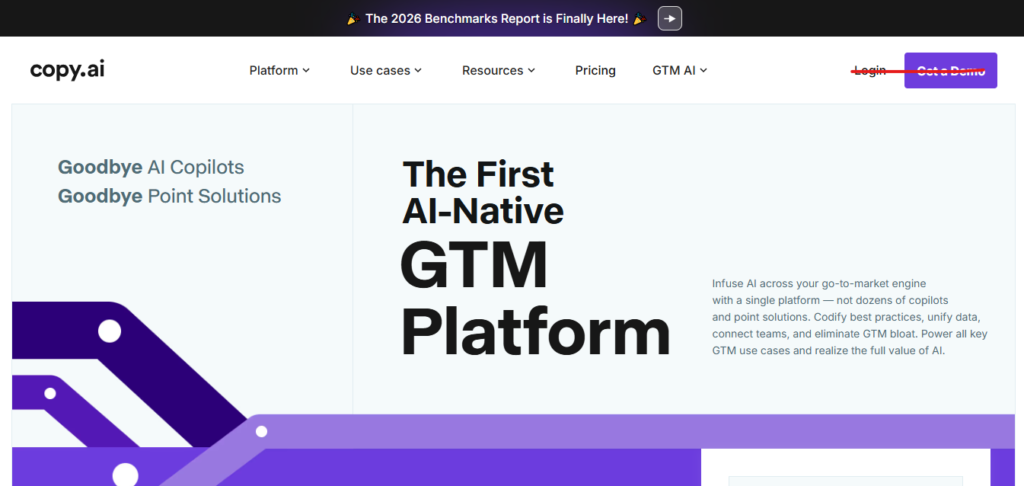
Since its founding in 2026, Copy.ai has grown to be the preferred option for marketers, content producers, and companies trying to optimize their content creation. Serving more than 15 million people worldwide and collaborating with companies like Nestle, Samsung, and Unilever, it has positioned itself as a GTM (Go-To-Market) AI platform. text.ai excels in creating quick, impactful marketing text for social media posts, advertising campaigns, and product descriptions.
AI Writing Capabilities
By utilizing several major language models, such as GPT-3.5, GPT-4, and Claude, Copy.ai enables users to take use of the distinct advantages of each engine for better content. The platform features AI Workflows that streamline repetitive tasks like email and blog drafting, as well as material Agents that produce material based on learning models from user examples.
4. Frase
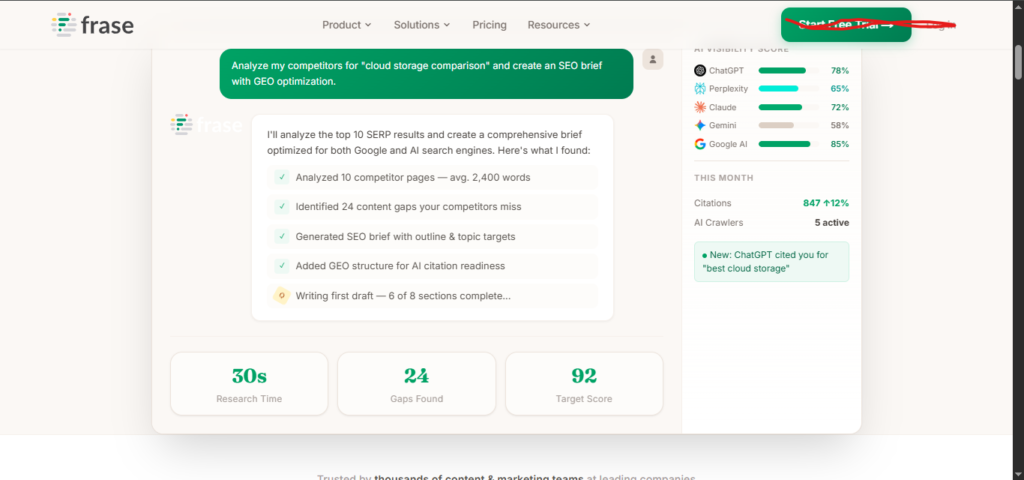
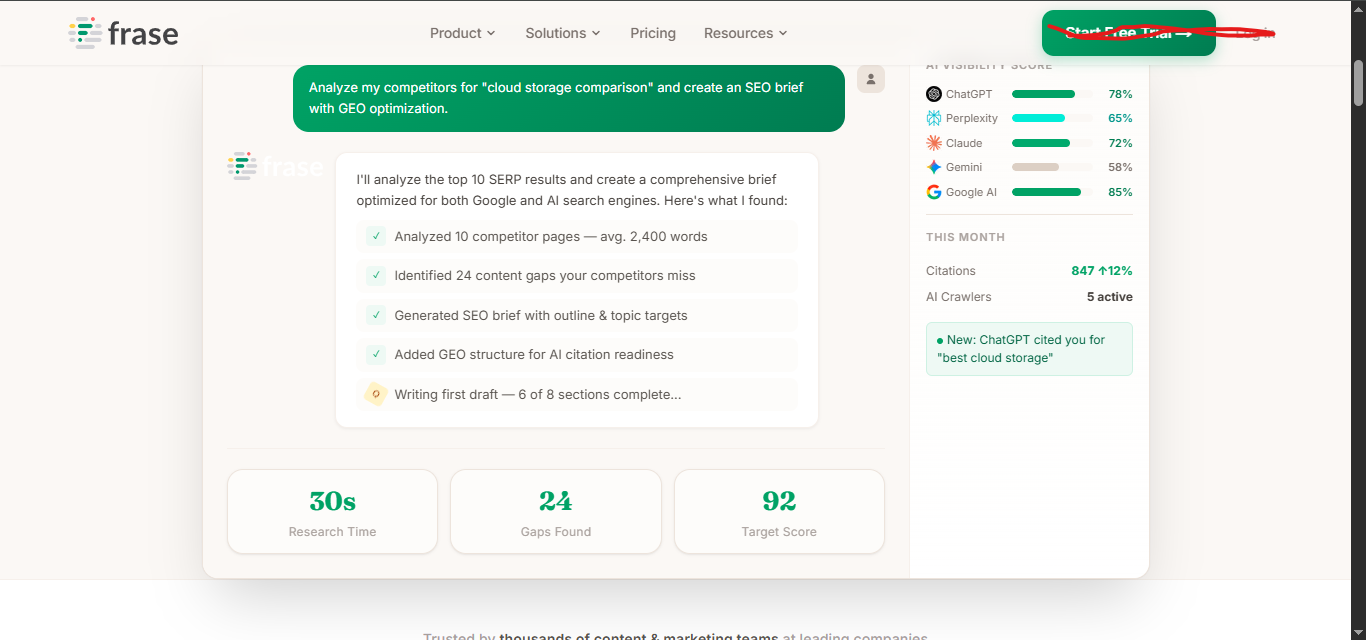
The only platform that optimizes content for both conventional search engines like Google and artificial intelligence search engines like ChatGPT, Perplexity, Claude, and Gemini is Frase. Frase helps you get cited by AI systems, whilst the majority of SEO solutions only concentrate on Google rankings. Frase speeds up and improves the data-drivenness of processes like creating content briefs, studying rivals, and attempting to rank for particular keywords.
AI Writing Capabilities
Frase now generates material using GPT-3, which supports a variety of content kinds and produces output that is almost identical to human writing. From a target term, the AI writer creates long-form, SEO- and AI search-optimized articles, managing research, drafting, and optimization automatically.
5. Jasper AI
One of the greatest AI writing tools is Jasper AI, which stands out for its capacity to generate customized, high-quality prose in a matter of seconds. Founded in 2015 under the name Jarvis and relaunched in 2026, Jasper is now regarded as one of the most widely utilized AI writing tools for marketers.
Jasper is designed to help you keep your brand language consistent throughout all of your marketing channels, including emails, blogs, and social media advertisements. Although it can handle long-form content like blog articles, it works best with shorter-form copy like headlines, product descriptions, LinkedIn biographies, or social media postings.
AI Writing Capabilities
Because Jasper is multi-model, it chooses the appropriate model from a range of large language models, such as GPT-4, Cohere, and Anthropic, to create text and visuals that most closely match your suggestions. The ability to establish the tone of your created content is one of Jasper’s primary capabilities. The AI will examine and imitate your brand voice if you feed Jasper current content, import your style guide, or add company information.
Personal Experience
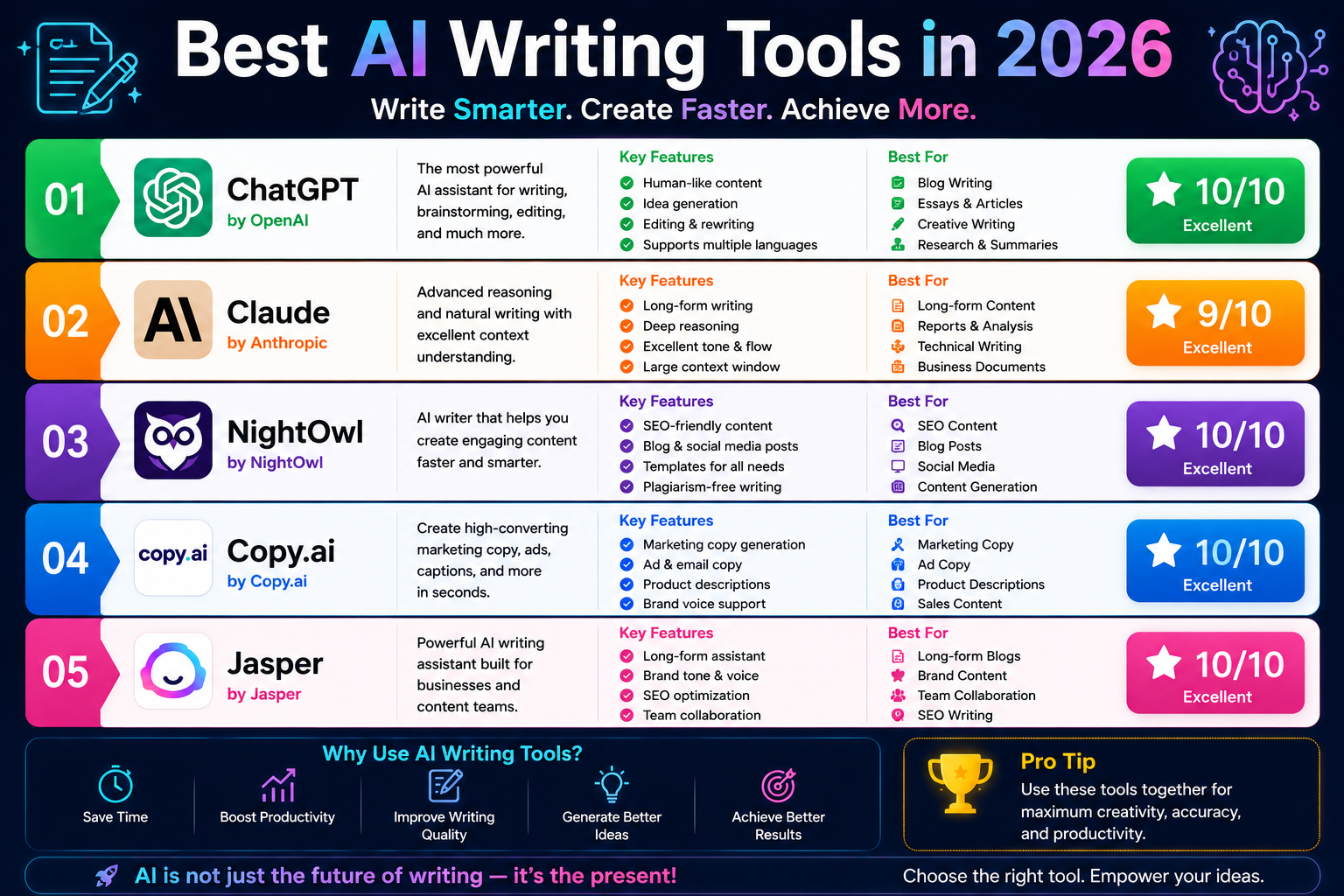
Nine months ago I started writing for my blog and creating content. I found that writing the content myself was really boring and it made me tired. I had talked to a lot of people. They told me that I could use artificial intelligence to help me with writing. So I did some research. I came across ChatGPT. I asked ChatGPT to write an article for me. I was surprised by the results. Then I also asked ChatGPT to write some blogs for me. They were written so well that it seemed like ChatGPT really knew what it was talking about.
While I was using intelligence to help me with my writing I found out about Anthropics Claude. I used Claude to create content for my clients website. It did an even better job than ChatGPT. I think Claude is great and I would give it a rating of 9 out of 10.
I also used tools like NightOwl and Copy.ai and Jasper to help me with my writing. These tools helped me create good articles and blogs and other content for my clients and for my own brand. I think these five artificial intelligence tools are all really good. I would give them a rating of 10 out of 10.
I think you should try these intelligence tools like I did. Based on my experience, with ChatGPT and Claude and NightOwl and Copy.ai and Jasper I think they can really help you with your writing.
AI Tool Spots is a technology-focused platform dedicated to sharing the latest updates in Artificial Intelligence, software tools, automation, SEO, and digital innovation. We publish informative guides, honest reviews, tech tutorials, and valuable resources to help bloggers, entrepreneurs, marketers, and tech enthusiasts stay ahead in the digital world. Learn more at aitoolspots.com.