In 2026, Perplexity AI is at its peak for quick research with referenced sources, up-to-date online results, and a more tidy response than Google search snippets. Its shortcomings include poor long-form writing, superficial reasoning on difficult tasks, citation dependability, and shallow coding depth. Perplexity Pro is only worth $20/month for recurrent research workflows, file uploads, source comparison, or model selection; the free plan suffices for informal research.
Accuracy and limitations verdict: Current research, summaries supported by citations, and quick source identification cause the most confusion. Citation quality fluctuation, sporadic source hallucinations, and overconfidence when the web results are sparse are its drawbacks. For research synthesis, use it instead of Google; for writing, planning, or complicated analysis, use it instead of ChatGPT or Claude.
Strengths and drawbacks in one sentence: Perplexity AI can be used to swiftly locate and compare sources; nevertheless, it should not be used as the ultimate authority for judgments pertaining to pricing, law, medicine, finance, or client-sensitive matters without first reviewing the cited pages.
Next action: Test Perplexity on a single research workflow before using it for marketing tasks. Use the RAG web browser for retrieval-intensive procedures, compare sources using the website content crawler, or ask for an AI marketing audit if you require a repeatable research system.
What Is Perplexity AI and Is It Worth It?
Perplexity AI is an AI-powered search engine that provides answers by conducting real-time online searches and combining findings with citations. It is more akin to a research assistant that takes the role of the “search → read ten tabs → synthesize” workflow than a chatbot. For everyday research, the free tier is quite helpful. If research is your major professional activity, the $20/month Pro tier is worthwhile; if you primarily write, build, or code, it is not.
What Perplexity AI Actually Is (And What It Is Not)
Essentially, Perplexity is an AI-based search interface. Each inquiry initiates a real-time online search, which the AI then combines into a single response with numbered citations. The sources are visible to you. You are able to click through. The response is always based on what is now available online rather than what an AI was trained on two years ago.
This makes Perplexity genuinely different from:
Google: Google returns links. Perplexity AI returns answers. You do not have to click anything.
ChatGPT (without web search): ChatGPT generates from trained knowledge with a knowledge cutoff. Perplexity AI is always current.
Claude: Claude (without tools enabled) has the same knowledge cutoff problem. Excellent at reasoning; poor at real-time information.
The drawback is the opposite of this strength: confusion is constantly searching and synthesizing. It struggles with tasks that call for creative output, innovative reasoning, or multi-step problem solving from scratch.
Free vs Pro: What You Actually Get
Free Tier
Perplexity’s free tier is one of the more honest freemium offerings in AI. You get:
- Unlimited standard searches, Perplexity’s own Sonar model with web access
- 5 Pro searches per day, accesses GPT-4o, Claude 3.5 Sonnet, or Sonar Pro depending on your setting
- Basic follow-up questions within a thread
- No file uploads
- No image generation
- No persistent “Spaces” (team workspaces)
The free tier meets the majority of needs for informal research, fact-checking, obtaining summaries, and finding up-to-date information. The primary limitation for frequent users is the five Pro searches per day.
Pro Tier ($20/month or $200/year)
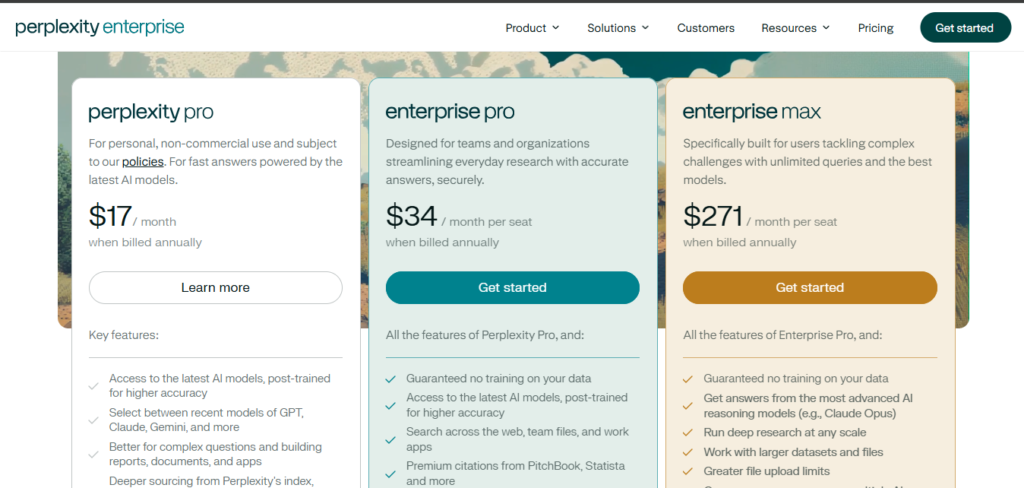
Perplexity AI Pro unlocks:
- Unlimited Pro searches, the biggest upgrade
- Model choice: Switch between GPT-4o, Claude 3.5 Sonnet, Gemini 1.5 Pro, and Sonar Pro per query
- File and image uploads, PDFs, documents, images
- Image generation (DALL-E 3 and Stable Diffusion)
- Perplexity AI Pages, publish research as shareable, formatted documents
- API credits ($5/month included)
- Higher rate limits across all features
The most underappreciated benefit is access to the Pro model. You can essentially get Claude, GPT-4o, and Gemini in one interface with web search for $20 per month. Each service would cost between $20 and $60 to subscribe to separately.
Where Perplexity AI Excels
1. Current Information With Sources
This is the fundamental strength of perplexity. You receive a summarized response with clickable citations whether you inquire about a news event from this week, a recent earnings report, or a competitor’s most recent price change. This process takes 90 seconds in Perplexity compared to 15 minutes in Google.
2. Research Synthesis
Perplexity excels at answering intricate research issues with numerous moving components. “What’s the current state of B2B intent data tools?” or “What are the main differences between ISO 27001 and SOC 2?” Perplexity uses a variety of reliable sources to effectively address problems.
3. Follow-Up Question Threading
Perplexity AI preserves context during a discourse, in contrast to a simple search engine. Without losing the flow of your study, you can refine the scope, ask a follow-up question, or ask for clarification.
4. Multi-Model Access on Pro
The ability to execute the same query through GPT-4o, Claude 3.5, or Sonar Pro, all with web search attached, is a significant productivity boost at $20/month. This is the cleanest package available at this price on any other platform.
5. Perplexity Pages
The ability to export any study thread into a prepared, shared “Page”—basically a research brief—is an underutilized capability. helpful for providing research without raw chat logs to a client or team member.
Where Perplexity Falls Short
1. The Citation Problem
This cannot be overstated. Perplexity AI cites sources with a confidence that is frequently unwarranted. Common issues:
- Cited statistics that the linked article never mentions
- Quotes attributed to reports where those quotes do not exist
- Outdated information from pages that have since been updated, presented as current
- The link exists, but the content has been changed since Perplexity cached it
The risk is not that the citations are sometimes inaccurate, all AI systems hallucinate. Citations have the risk of making you less vigilant. When an incorrect response is accompanied with a source, it appears authoritative. When utilizing a Perplexity-cited fact in professional work, always consult the original source.
2. Weak at Creative and Long-Form Tasks
Perplexity AI is not a writing tool; rather, it is a research tool. If you ask it to write a 1,000-word blog introduction, you will receive a piece that was built from search results rather than original content. It lacks a consistent narrative throughout a lengthy paper, a persistent creative voice, and a memory of your brand rules.
3. Weak at Coding
Not a code interpreter. Code cannot be run or tested. Claude or ChatGPT are far more powerful for pure code generation. While Perplexity can locate documentation and explain code, it is not the best tool for creating production code.
4. Privacy and Data Practices
By default, Perplexity employs queries to enhance its systems. The corporation was heavily criticized in 2024 for its web crawler that scraped content from websites that had specifically opted out, disregarding robots.txt directives. Compared to OpenAI or Anthropic, their data retention and training data policies are less clear.
Don’t enter private customer information, unannounced product details, or delicate company plans into Perplexity. This holds true for both Pro and Free.
Perplexity AI Tested Across 6 Use Cases
Here is how Perplexity performs across the use cases that matter most to real users, with an honest verdict on each.
Use Case 1: Research and Information Synthesis
Perplexity’s reputation is earned in this way. When you pose a multifaceted research query, such as “What are the main regulatory differences between ISO 27001 and SOC 2 for a SaaS company?” Perplexity AI draws from reliable sources, synthesizes them into a logical response, and connects each assertion. The browser tab workflow, which used to take 20 minutes, now only takes 90 seconds.
Where it receives an asterisk: Perplexity synthesizes from whatever is available, even low-quality sources, for specialized subjects with little high-quality web coverage. Regardless of the quality of the source, the response appears equally confident.
Use Case 2: Fact-Checking
Perplexity is quicker than Google at determining whether a statistic or assertion is backed up by reliable sources. In one view, you can see the quote, the source, and the surrounding context. The issue: Perplexity AI occasionally presents a fact as mentioned when it isn’t there in the cited article. Anything that is important must be clicked through. Use it to choose the correct course; manually confirm the particular assertion.
Use Case 3: Writing Assistance
Text is assembled from search results by Perplexity. It synthesizes rather than writes. When you ask it to write a 600-word blog introduction, the result is a logical but robotic topic sentence, three supporting ideas, and a generic conclusion. There is no narrative tension, no creative voice, and no reader-specific structure. For writing assignments, Claude or ChatGPT-4o are unquestionably superior. Research the subject using Perplexity, then write about it using a different technique.
Use Case 4: Coding Help
There is no code interpreter for perplexity. Code cannot be run, tested, or debugged by it. It is useful for finding pertinent documentation, elucidating a subject, or directing you to a library. ChatGPT or Claude are significantly superior for creating production code, debugging a function, or producing a functional implementation. Perplexity should not be your main coding helper.
Use Case 5: Summarization
Perplexity does a good job of summarizing current affairs and themes from multiple sources. You can acquire a concise, cited summary of the present situation of AI regulation in the EU by asking it to do so. Nevertheless, it needs Pro’s file upload feature to summarize a particular document you paste in. Claude or ChatGPT are superior choices for document summarizing on the free tier.
Perplexity AI for Professionals: Use Cases by Field
Marketing and Competitive Intelligence
For watching rival actions, keeping an eye on industry news, and creating research briefings on subjects like price adjustments, new product launches, or changes in advertising strategy, Perplexity is a powerful tool. Compared to a weekly manual review, a daily Perplexity search on your top three competitors yields more up-to-date information in five minutes. When sharing research with stakeholders, it is very simple to link to the original source thanks to source transparency.
Journalism and Editorial Research
As a first-pass research method, perplexity is effective in locating sources, determining angles, and creating background information. It shouldn’t be utilized on its own as a primary source. This is a particularly pertinent example of the citation issue: in editorial work, never reference “Perplexity says”; instead, always trace the assertion to its original source.
Legal and Medical Research
Not for clinical or legal decisions, but useful for background research. Perplexity can assist a doctor in reviewing the most recent treatment guidelines or a lawyer in rapidly comprehending a new regulatory area. However, any claim used in a professional setting must be linked to the original source due to the citation accuracy issue, which is common procedure in both areas. Don’t enter patient or client case details.
Finance and Investment Research
Strong for rapidly combining news of macro events, analyst sentiment, and recent earnings comments. Weak for intricate financial modeling or secret data. Perplexity AI cannot take the place of Bloomberg or a major data source, but it can provide you with a helpful summary of what the market is saying about a company.
Academic and Student Research
helpful for getting acquainted with a new subject. Perplexity citations are inappropriate for academic work citations and do not qualify as primary source verification. Go to the primary source after using it to determine which journals, authors, and papers to examine.

AI Tool Spots is a technology-focused platform dedicated to sharing the latest updates in Artificial Intelligence, software tools, automation, SEO, and digital innovation. We publish informative guides, honest reviews, tech tutorials, and valuable resources to help bloggers, entrepreneurs, marketers, and tech enthusiasts stay ahead in the digital world. Learn more at aitoolspots.com.