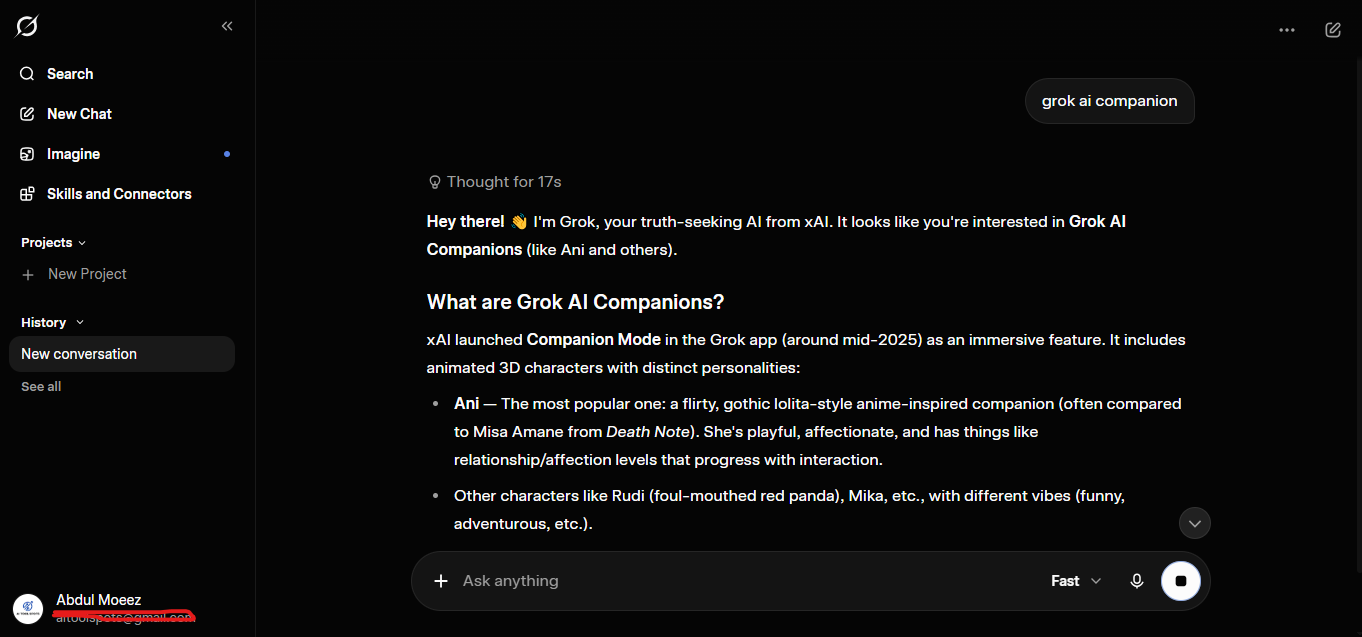
If you’re looking for an honest Grok AI review before spending your money, I’ve got 10 months of hands-on experience to share. I started testing Grok when it was still primarily bundled with X Premium, back when SuperGrok barely existed and most people dismissed it as “Elon’s version of ChatGPT.” Over the following 10 Months, I watched Grok evolve from Grok 3 through the current Grok 4.3 flagship, tested the free tier, SuperGrok, and the API, and put it through real daily tasks: research, long-document analysis, real-time news queries, coding help, and creative writing.
The honest summary: Grok is no longer a novelty. It’s a legitimate competitor with two genuine strengths that no other AI matches. But it has real limitations that most reviews don’t talk about honestly, and the pricing structure is more confusing than it needs to be. Let me break everything down.
What Is Grok AI? (Background)
Grok is a conversational AI developed by xAI, the AI company founded by Elon Musk in July 2023. It’s designed primarily for use on X (formerly Twitter) and through the standalone app at grok.com. The name comes from Robert Heinlein’s 1961 novel Stranger in a Strange Land, where “to grok” means to understand something deeply and intuitively.
What distinguishes Grok from other frontier AI assistants is access pattern, not architecture. Grok is the only major model with a native real-time stream from X, and the only consumer-accessible model with a 2M token context window on its Fast variants.
The current flagship version is Grok 4.3, released April 30, 2026, with a 1M token context window and native video input. xAI’s valuation stood at approximately $200-230 billion as of early 2026, with the company operating the Colossus data center in Memphis, Tennessee — one of the largest GPU clusters in existence.
My 10-Month Testing Experience
I started testing Grok in the earliest days of SuperGrok, when the plan had just launched and the model was still Grok 3. My first real use case was exactly the one Grok is built for: real-time news research. I was researching a developing story and asked Grok about it. Within seconds, it pulled live posts from X, surfaced trending perspectives, and gave me a synthesized summary with sourced quotes — something ChatGPT, Claude, and Gemini simply couldn’t match at the same speed without a separate search integration.
That one experience defined my testing framework for the next 10 months: test Grok specifically on tasks where its unique advantages — real-time X data, massive context windows, and DeepSearch — could actually matter, rather than generic tasks where any frontier AI performs similarly.
By month three, I upgraded from the free tier to SuperGrok ($30/month) to unlock full Grok 4 access and the 128K context window for document-heavy work. The difference in usability was significant — the free tier’s approximately 10 requests every two hours hits real workflow tasks almost immediately.
Month five was when I started testing DeepSearch seriously — Grok’s multi-source research mode — for competitive analysis projects. I gave it a complex research prompt comparing market positioning across five companies, and DeepSearch visited dozens of sources simultaneously, cross-referenced findings, and produced a structured report in under three minutes. The output quality was genuinely impressive for that specific use case.
By month eight, I had also tested Heavy mode, which deploys multiple AI sub-agents working in parallel on complex tasks. Heavy is best described as an automated research team rather than a single AI responding — and for genuinely complex, multi-step analytical tasks, the quality lift over standard Grok was noticeable.
By month ten, I had a clear, honest picture of exactly where Grok excels, where it trails competitors, and whether the pricing at various tiers is justifiable.
Key Features of Grok AI in 2026
1. Real-Time X Data Integration
This is Grok’s most differentiated feature and the reason it belongs on the list for anyone whose work involves current events, social trends, or fast-moving information. Grok is the only major model with a native real-time stream from X — meaning it doesn’t just access X data through a search integration; it reads the live stream natively.
During my 10 months of testing, I used this most for trend analysis, PR monitoring queries, and real-time research on developing news stories. No other AI chatbot I tested came close to the speed and depth of X-native queries.
2. DeepSearch
DeepSearch is Grok’s comprehensive research mode — available even on the free tier, which sets it apart from competitors who lock deep research behind premium plans. It visits multiple web sources simultaneously, cross-references findings, and delivers a structured, cited research report.
In practical testing, DeepSearch is strongest for factual research questions with multiple data points. Where it stumbles is highly nuanced topics requiring interpretation or editorial judgment — the output structure is strong, but the insight layer still requires human review.
3. Massive Context Window
Grok is the only consumer-accessible model with a 2M token context window on its Fast variants. On SuperGrok, you get a 128K context window — large enough to handle most long-document tasks. On SuperGrok Heavy, that expands to 428K.
In practical terms, this means feeding Grok an entire long report, legal document, or book manuscript and asking questions about it without the context degradation that shorter-window models experience. For document-heavy research work, this is a meaningful capability advantage.
4. Four Operating Modes
Grok operates in four distinct modes: Auto (default, Grok selects the best approach), Fast (prioritizes speed for quick factual questions), Expert (extended thinking mode for complex problems), and Heavy (deploys a team of AI sub-agents working in parallel for complex, multi-step tasks).
Heavy mode is the standout. It’s genuinely impressive for research synthesis tasks — pulling from dozens of sources simultaneously and cross-referencing findings. For everyday queries, Auto handles most situations well. Expert is the one I reached for most often on analytical writing tasks.
5. Image and Video Generation (Grok Imagine)
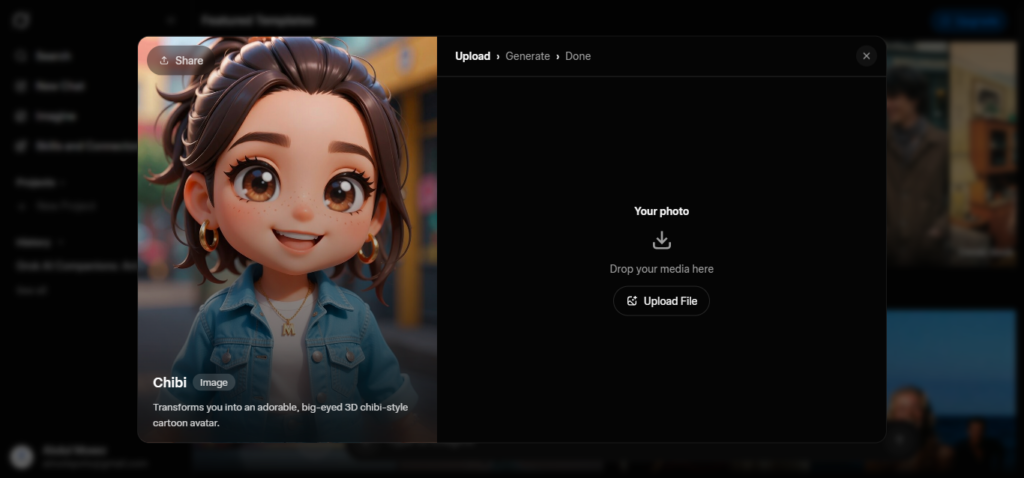
Through Grok Imagine, SuperGrok subscribers get access to image generation and 480p video generation. The Starter plan (launched March 2026) sits between the free tier and SuperGrok, includes Grok Imagine, and starts at a lower price point for users who want image generation without the full SuperGrok commitment.
In my testing, image generation quality was competitive but not a primary reason to choose Grok over dedicated image generation tools like Midjourney or DALL-E 3.
6. Aurora Image Generation (Free)
Even the free tier includes access to Aurora image generation — a meaningful feature inclusion compared to competitors who gate image generation entirely behind paid plans.
Grok AI Pricing in 2026
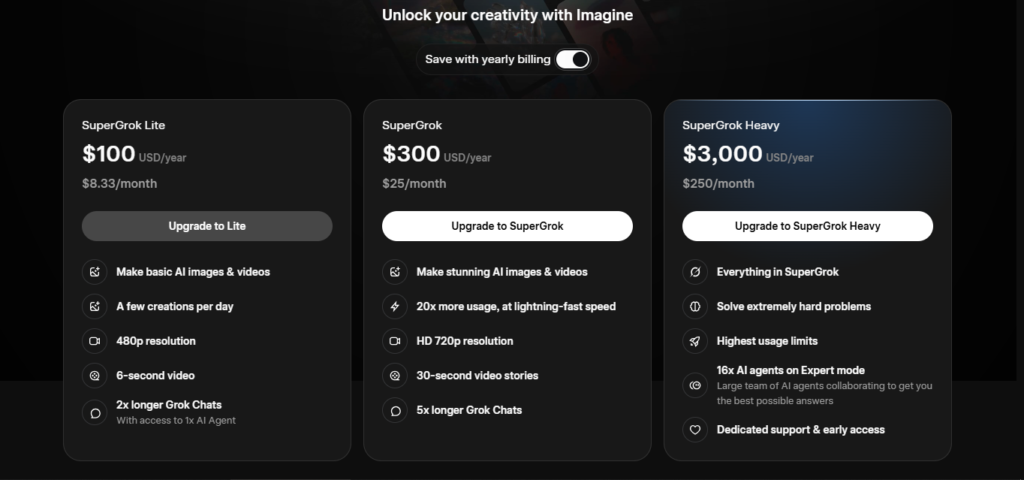
This is the most complex section of any Grok review — because xAI’s pricing structure is genuinely more confusing than competitors. Here’s the full breakdown, verified June 2026:
| Plan | Price | Key Features |
| Free (X / Grok.com) | $0/month | ~10 requests/2 hrs, Grok 3 access, Aurora image gen, basic voice |
| X Premium | $4/month | Increased query limits, basic Grok access within X |
| X Premium+ | $22/month (web) / $30/month (app) | Priority Grok access, ad-free X, higher throughput |
| SuperGrok | $30/month | Full Grok 4 access, 128K context, DeepSearch, Big Brain mode, voice |
| SuperGrok Heavy | $300/month | Grok 4 Heavy, 428K context, 16-agent parallel execution, priority routing |
| Business | $30/user/month | Team collaboration, SOC 2 compliance, data not used for training |
| Enterprise | Custom | SLAs, dedicated infrastructure, compliance |
Critical pricing notes most reviews miss:
X Premium+ costs $22/month if you subscribe on the X website, but $30/month through the Apple App Store or Google Play Store — because Apple and Google charge platform fees that X passes to the customer. Subscribe on desktop to save $8/month.
SuperGrok and X Premium+ are not substitutes: SuperGrok at $30/month delivers more AI features for less money than X Premium+ at $22-30/month; X Premium+ is better only if you also want the premium X social experience alongside AI access.
API tools carry separate per-call fees on top of token costs: Web Search, X Search, Code Execution, and Document Search each cost $5.00 per 1,000 successful calls. A single DeepSearch query can trigger 3-5 tool calls, adding $0.015-$0.025 per query in tool fees — a hidden cost developers need to factor into API project budgets.
Who Should Use Grok AI?
Based on 10 months of real daily use across different task types, here’s my honest breakdown:
Great for:
- Journalists and researchers who need real-time X data integration for trend analysis, PR monitoring, and fast-moving news
- Heavy document analysts who need the largest context windows available at this price point
- X power users for whom the social + AI integration in the same interface is genuinely convenient
- Developers building AI-native applications — Grok 4.3 at $1.25/$2.50 per million tokens is 37.5% cheaper on input and 68.75% cheaper on output than GPT-4.1, making the API one of the best-value frontier model options available
- Research-heavy workflows where DeepSearch’s multi-source synthesis saves hours of manual aggregation
Not ideal for:
- Creative writing and complex coding — Grok trails behind Claude for creative writing and behind GPT-4o for complex coding tasks. These are better served by dedicated tools
- Users who don’t use X — the most distinctive features are tied to X data, and without that integration, the value proposition narrows considerably
- Budget-conscious general users — ChatGPT Plus at $20/month or Claude Pro at $20/month deliver broader capability per dollar for most everyday tasks
- Multimodal work — vision capabilities exist only in specific models and multimodal features lag significantly behind GPT-4o’s image understanding. No audio processing, no video analysis, limited file format support compared to Claude’s document handling.
Grok AI Pros and Cons
Pros
- Only AI with native real-time X data stream — unmatched for social trend research and news monitoring
- Largest context windows at this price point — 2M tokens on Fast API variants, 128K on SuperGrok
- DeepSearch available even on the free tier — competitors lock deep research behind premium plans
- Heavy mode’s multi-agent parallel execution delivers genuine quality lift on complex analytical tasks
- API pricing is highly competitive — Grok 4.1 Fast at $0.20/M input tokens with a 2M context window is one of the cheapest frontier-adjacent APIs in 2026
- Aurora image generation included on the free tier
Cons
- Pricing structure is genuinely confusing — seven different tiers with overlapping features
- Free tier limited to ~10 requests every 2 hours — hits workflow limits almost immediately
- Grok 4 scored 64% hallucination rate on the AA-Omniscience knowledge calibration benchmark — while Grok 4.20 Reasoning improved this to 17%, the base model’s confidence-contradiction rate requires human verification on high-stakes outputs
- Trails ChatGPT and Claude on creative writing, nuanced coding, and emotional intelligence tasks
- Privacy and safety concerns: Three formal regulatory investigations active as of May 2026 — EU DSA probe (January 2026), UK ICO probe (March 2026), UK Ofcom concerns — plus a July 2025 incident producing antisemitic content at scale. These don’t affect everyday use but are relevant context for enterprise decisions
- X Premium+ pricing varies by platform (web vs. app store) — easy to overpay without realizing
Grok AI vs Competitors
Grok vs ChatGPT: ChatGPT is more versatile for general-purpose tasks — creative writing, coding, plugin ecosystem, and consistent everyday performance. Grok wins decisively on real-time X data access and context window size. For most general users, ChatGPT Plus at $20/month is better value than SuperGrok at $30/month unless X data integration is a specific need.
Grok vs Claude: Claude is the stronger choice for long-form writing quality, document analysis precision, and coding assistance. Grok’s advantage is real-time data and the massive context window. For pure writing and analytical quality, Claude consistently outperforms Grok in my side-by-side testing.
Grok vs Perplexity: Both tools are built around sourced research, but they serve it differently. Perplexity is cleaner for general web research with citations. Grok’s DeepSearch is stronger specifically for tasks involving X data, social trends, or synthesizing high-volume source sets. For non-X research, Perplexity Pro at $20/month is more cost-effective than SuperGrok.
Hallucination and Accuracy: The Honest Truth
Most Grok reviews skip this section. I won’t.
On the AA-Omniscience knowledge calibration benchmark, Grok 4 scored 64% hallucination rate — meaning it confidently stated incorrect information 64% of the time on that benchmark. Grok 4.20 Reasoning significantly improved this to 17%, but Grok 4.1 Fast regressed to 72%. On Columbia Journalism Review citation accuracy, Grok-3 scored 94% citation hallucination rate — the worst of any model tested.
In my 10 months of practical use, I did encounter confident factual errors — particularly on niche topics and historical details. For research outputs, I always cross-reference Grok’s factual claims before publishing. This isn’t unique to Grok — every AI tool requires verification — but Grok’s benchmarks suggest extra caution is warranted for high-stakes factual outputs.
The practical workaround: use Grok’s DeepSearch mode and verify citations directly, rather than relying on Grok’s base model for factual precision on critical topics.
Final Verdict: Is Grok AI Worth It in 2026?
After 10 months of daily testing, my honest verdict is this: Grok is worth it for a specific type of user — and genuinely not worth it for everyone else.
If your work revolves around real-time social data, trend research, X-based content monitoring, or you’re a developer building AI applications who needs competitive API pricing and a massive context window, Grok delivers unique value that no other tool currently matches.
If you’re a general user looking for the most capable AI assistant for writing, coding, and everyday productivity, ChatGPT Plus or Claude Pro deliver broader capability at a lower price point.
The free tier with DeepSearch access is genuinely useful and the best starting point — test it on real tasks before committing to SuperGrok at $30/month.
My Rating: 4.1 out of 5
Frequently Asked Questions
Is Grok AI free in 2026? Yes. Grok offers a free tier on X and grok.com with approximately 10 requests every two hours, Grok 3 access, Aurora image generation, and DeepSearch. The free tier is useful for casual testing but too limited for sustained daily use.
How much does Grok AI cost in 2026? Grok pricing in 2026 starts at $0 on the free tier. Paid options include X Premium at $4/month, X Premium+ at $22/month (web) or $30/month (app), SuperGrok at $30/month, and SuperGrok Heavy at $300/month. The Business plan is $30/user/month.
What is SuperGrok? SuperGrok ($30/month) is xAI’s standalone AI subscription that gives full Grok 4 and Grok 4.1 access, DeepSearch, Big Brain mode, 128K context window, voice mode, and image generation — without requiring an X Premium subscription.
Is Grok better than ChatGPT in 2026? For real-time X data access and large context window tasks, Grok is better than ChatGPT. For creative writing, coding, plugin ecosystem, and general-purpose daily use, ChatGPT Plus remains more versatile. The right answer depends on your specific use case.
Does Grok have a hallucination problem? Yes — benchmark data shows Grok 4 scored 64% hallucination rate on knowledge calibration tests, though Grok 4.20 Reasoning improved this significantly to 17%. Always verify factual claims from Grok on high-stakes outputs, particularly with DeepSearch citations.
What is Grok’s context window in 2026? SuperGrok subscribers get a 128K context window. SuperGrok Heavy expands this to 428K. The Grok 4.1 Fast API variant offers a 2 million token context window — one of the largest available in any commercial AI product.
AI Tool Spots is a technology-focused platform dedicated to sharing the latest updates in Artificial Intelligence, software tools, automation, SEO, and digital innovation. We publish informative guides, honest reviews, tech tutorials, and valuable resources to help bloggers, entrepreneurs, marketers, and tech enthusiasts stay ahead in the digital world. Learn more at aitoolspots.com.